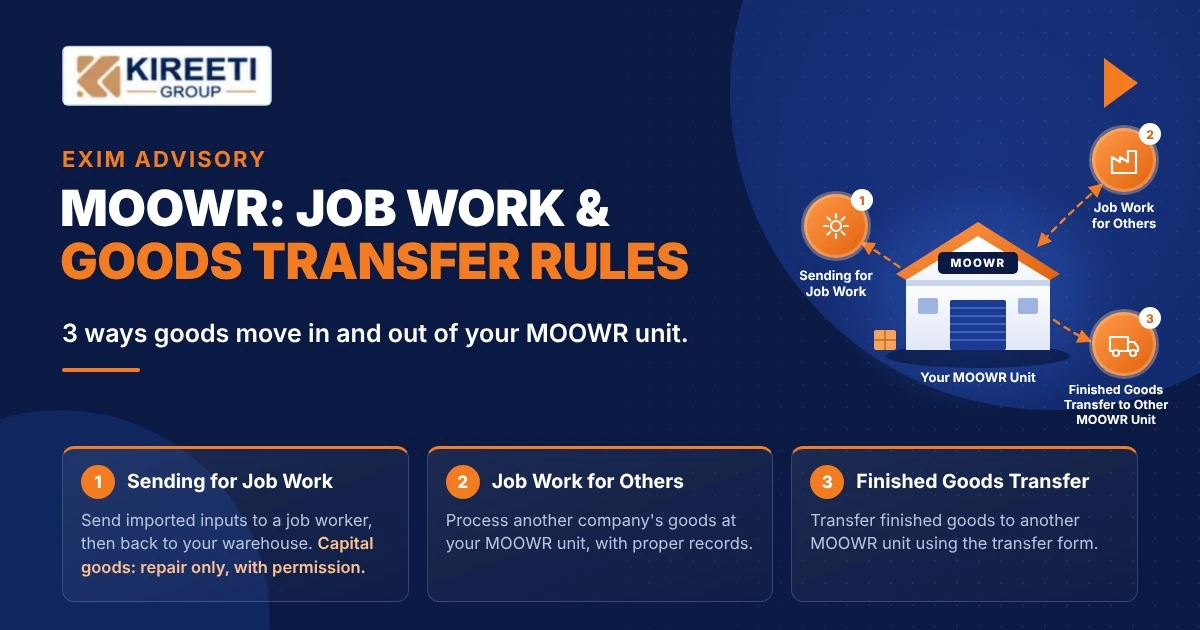
Under MOOWR, imported inputs can be sent for job work, and resultant goods can be moved to another MOOWR unit, subject to the prescribed conditions.
Quick Facts
| Particular | Key Information |
|---|---|
| What is MOOWR | A scheme where you import capital goods or raw material into a bonded warehouse without paying customs duty upfront. The duty is deferred, not exempted (Circular 34/2019-Customs). |
| Job work | Imported inputs can go out of the warehouse for job work. The capital goods also can go out but for repairs only, permission must be sought from the bond officer. |
| Transfer | Resultant goods can move to another MOOWR unit on the prescribed transfer form, with the bond officer informed (Instruction 16/2024-Customs; MOOWR Regulations, 2019, Reg. 13). |
| Duty | Deferred duty is payable when the relevant goods are cleared for home consumption (Instruction 16/2024-Customs; Customs Act, Section 68). |
Scroll left to see the full table
Three Different Activities
- Sending your imported inputs outside of your unit for job work.
- Doing job work for another company at your MOOWR unit.
- Transferring your finished goods to another MOOWR unit.
Each follows a different procedure, so identify the right route before dispatch.
1. Sending Imported Inputs for Job Work
Which goods can go
- Imported inputs: Yes, only inputs allowed for job work.
- Capital goods: Capital goods are permitted, but this only applies to repair work; additionally, permission has to be requested from the bond officer (Circular 48/2020-Customs).
Conditions
- Deposit first. Imported goods must first be deposited in your Section 65 premises and accounted for (Circular 48/2020-Customs).
- Keep them traceable. Record the outward movement and return in your monthly accounts (Circular 34/2019-Customs, Annexure B).
- Return or clear properly. The goods can return to your unit or be exported or cleared to the DTA from the job worker's premises. The date of removal from the job worker's premises is treated as the date of removal from the warehouse (Circular 48/2020-Customs, Regulations 14 and 15).
- Waste from the job work. Scrap, waste or remnants must return to your unit or be cleared on payment of applicable duty (Circular 48/2020-Customs).
- Bond. Your bond continues in force while the goods are with the job worker (Circular 34/2019-Customs, Annexure C).
If the conditions are not followed
The goods are deemed cleared for home consumption on the date they were sent for job work. Applicable duty, interest and penalties may then arise (Circular 48/2020-Customs).
2. Doing Job Work for Another Company
A MOOWR unit can also do job work for other companies. In simple words, your unit can take goods from another company, do the required work on them and return the goods to the owner.
What about customs duty?
If you use your own imported materials stored under MOOWR for this work, customs duty on those materials has to be paid when the processed goods are returned to the owner. For this, an ex-bond Bill of Entry has to be filed.
But if the processed goods are exported from your MOOWR unit, customs duty on the imported materials used for that work need not be paid, provided the required conditions are followed.
The unit should also keep records of the goods it received, the materials used, and the goods which are returned or exported. The prescribed GST and MOOWR rules should be followed.
3. Transfer of Finished Goods to another MOOWR Unit
Instruction 16/2024-Customs allows transfer of finished goods between two MOOWR units, but subject to the MOOWR conditions. For unprocessed imported goods, confirm the procedure with your bond officer first.
- Before dispatch. Fill in Part A of the transfer form. Say the name of the product being sent, and the name of the imported product used to manufacture the product. With this form, you need to notify the bond officer.
- Transport. The sending unit must put a one-time lock. The Commissioner may permit the goods to be transported without this lock, in certain circumstances.
- Upon arrival of the goods at the other unit. The receiving unit should inspect the lock and ensure that the goods received are consistent with the information on the transfer form. It then has to fill in Part B of the form.
- After the transfer. Both units account for the resultant goods, the warehoused goods contained in them and the duty, and file monthly returns accurately.
Duty: Customs duty is not payable just because you are transferring your resultant goods to another MOOWR unit, provided the prescribed procedure is followed. Duty on the imported goods contained in those products will become payable when the resultant goods are cleared for home consumption by filing an ex-bond Bill of Entry.
Common Mistakes to Avoid
- Sending goods for job work before recording them in your warehouse. First, you should bring the imported goods into your Section 65 warehouse, and then you should make a record of that. After that, you can send them to the job worker by following the relevant procedure.
- Sending capital goods outside the warehouse without any permission. If your capital goods need repair, get permission from the bond officer before sending them outside your MOOWR unit. This rule is explained in Circular No. 48/2020-Customs.
- Thinking your responsibility ends when goods leave the warehouse. Sending goods to a job worker does not end your responsibility for them. Keep a proper record of the goods sent, the work done and the goods received back.
- Transferring goods without the proper documents. When sending resultant goods to another MOOWR unit, complete the required papers and follow the rules for transport, insurance and bond records.
How Kireeti Group Helps
Kireeti Group can support you with:
- Checking whether your business is eligible for MOOWR
- Understanding MOOWR for imports, exports and domestic sales
- Assistance with the MOOWR licence application
- Post-licence requirements, including monthly returns
- Guidance on job work and transfer of goods
- MOOWR records and ongoing compliance
From checking eligibility to getting your licence and handling post-licence requirements, Kireeti Group guides you throughout your MOOWR journey.
Official Sources
- Customs Act, 1962: Sections 65, 68 and 69
- Notification No. 69/2019-Customs (N.T.) dated 1 October 2019: MOOWR Regulations, 2019
- Circular No. 34/2019-Customs dated 1 October 2019
- Circular No. 48/2020-Customs dated 27 October 2020
- CBIC Instruction No. 16/2024-Customs dated 25 June 2024