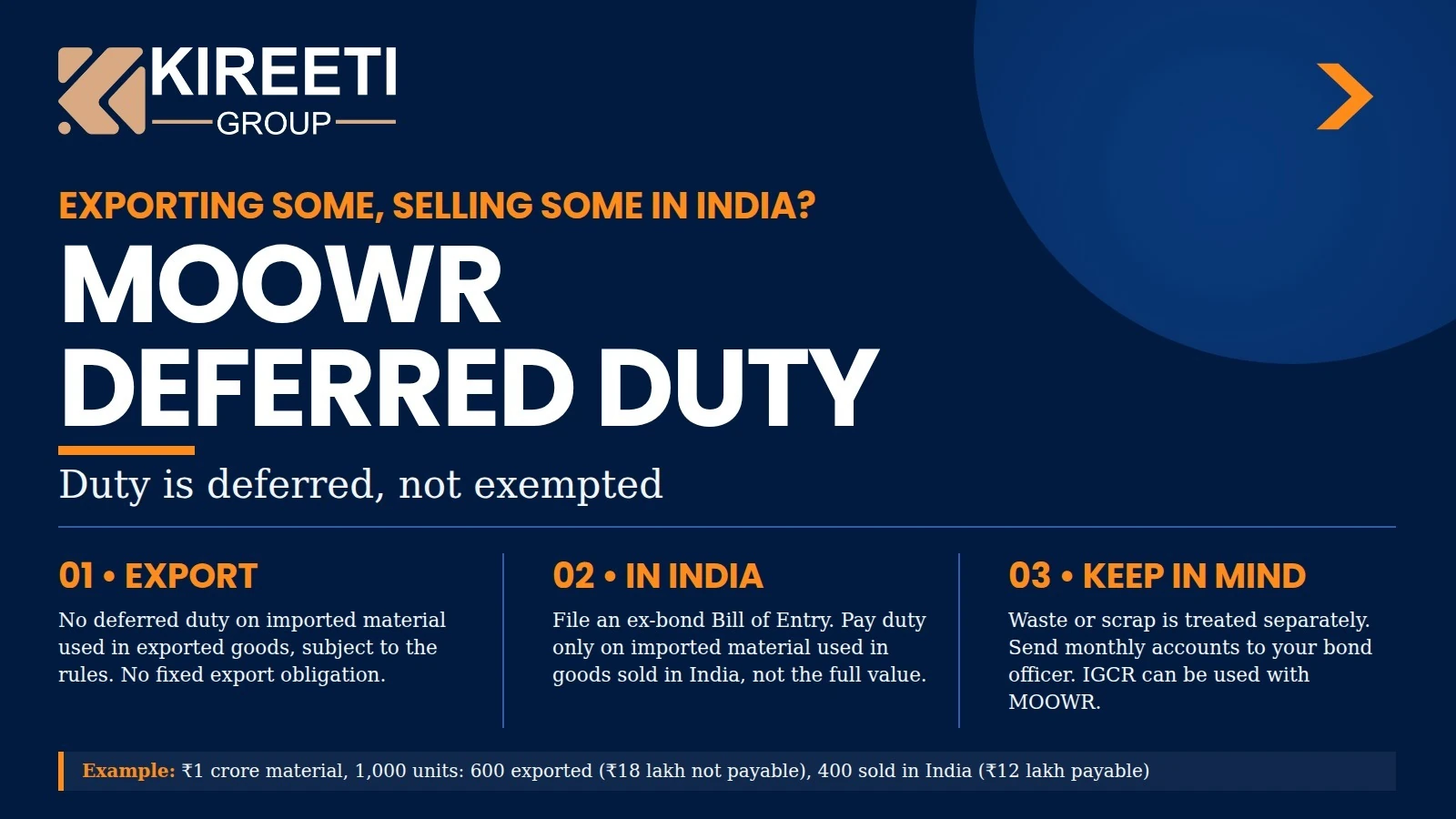
A simple guide which can be used by the businesses that export some of the finished goods and sell the rest in India.
Short Answer
Under MOOWR, you don't pay customs duty at the time of import. You pay later, and only on the imported material that you used in the resultant product which you sold in India. Under the rules, if you export the goods, then the deferred duty will be waived. GST is separate in both cases.
Quick Facts
| Particular | Key Information |
|---|---|
| What is MOOWR | The MOOWR scheme allows you to import capital goods or raw material into a bonded warehouse without paying customs duty immediately at the time of import. This duty is deferred, not exempted. After manufacturing your resultant product, you can export the resultant goods or sell them in India. Here, there is no fixed export obligation, unlike the EPCG and Advance Authorisation schemes. |
| If you export | No need to pay the duty which was deferred on the imported material which is used in this export product. |
| If you sell in India | You need to file an ex-bond Bill of Entry when you are removing goods from the warehouse. Here you need to pay Customs duty only on the imported material which you used to make the resultant product which you are selling in India. You need to charge GST normally. |
| Waste or scrap during manufacturing | Treatment depends on where the finished goods go. For exported goods, the waste should be destroyed, or you need to pay duty on it. |
| IGCR special case | A separate scheme for lower duty on certain goods, usually for short manufacturing cycles (goods to be used within six months of import). Can be used with MOOWR if both sets of conditions are met. |
Scroll left to see the full table
When Do You Pay?
1. When You Export Finished Goods
You generally do not pay customs duty on the imported materials used in the exported products, subject to the applicable rules. For GST, exports are zero-rated. You can export under an LUT or pay IGST and claim a refund, as applicable.
2. When You Sell Finished Goods in India
You must pay customs duty on the imported materials used in the products sold in India. This duty is paid through an ex-bond Bill of Entry. You must also charge GST on the sale.
3. When You Clear Imported Goods Without Using Them
If you take the imported goods out of the warehouse without using them, you must pay the applicable customs duty. Interest, fines or penalties may also apply. GST will apply as per the rules.
4. When You Export Imported Goods Without Using Them
You can export the imported goods without paying customs duty, subject to the applicable rules. Check the GST treatment based on the transaction.
What Happens to Waste or Scrap?
Waste from making your product may contain imported materials. What happens to the waste depends on where the finished product goes.
- Finished product exported: The waste must be destroyed, or customs duty must be paid on it as if it were imported in that form. If neither is done, duty on the imported materials in the waste will not be waived.
- Finished product sold in India: Customs duty must be paid on the imported materials in the waste when it is cleared.
- GST: Check GST on the sale of waste separately.
How Much Do You Pay on the India Portion?
When you sell some of your finished goods in India, you need to check three things: customs duty, GST and input tax credit.
1. Customs Duty (Only on Imported Materials)
- You do not pay customs duty on the full value of your finished product. Duty is worked out on imported raw materials used in finished goods that are sold in India.
- Keep records to show how much imported material was used in the goods you sell.
- To take the goods out of the warehouse, you must file a Bill of Entry called an ex-bond Bill of Entry.
2. GST on Your Sale
- When you sell finished goods in India, you must charge GST as per the normal GST rules.
- The value on which GST is charged is worked out under GST rules.
- Customs duty and GST are separate. You must check both.
3. Input Tax Credit
- You may claim input tax credit (ITC) for the IGST paid through the Bill of Entry, if you meet the conditions under GST rules.
Interest, Fines and Penalties
Under MOOWR, you can pay import duty later, when you take goods out of the warehouse for sale in India. But the duty is not cancelled. You may also have to pay interest, fines or penalties if you do not follow the rules.
- When goods or waste are cleared in India: You must pay the applicable customs duty and complete the required paperwork. For finished goods that are exported, duty on the imported materials used in them is not charged, subject to MOOWR rules.
- If you break the rules: You may have to pay duty, interest, fines or penalties. This may happen if you take goods out without the right papers, fail to pay duty or do not follow the rules.
- If you sell imported goods without using them in manufacturing: Interest may apply in some cases, depending on the goods and the rules.
Keep These Records
Keep proper records of all imported goods. Customs may check them at any time.
- Monthly accounts: Keep the accounts in the required format and submit them to your bond officer every month. Show what goods came in, what you used, what you made, what you exported, what you sold in India and what waste was left.
- Imported materials: Keep records showing which imported materials were used to make each finished product.
- For every sale in India: Keep the ex-bond Bill of Entry and GST invoice.
- For every export: Keep the shipping bill and GST invoice.
Example
A factory imports raw materials worth ₹1 crore and keeps them in a bonded warehouse under MOOWR. It makes 1,000 finished units. Out of these, it exports 600 units and sells 400 units in India.
In this case, it will be assumed that a constant quantity of imported material is used in each unit.
- 600 units exported: These contain ₹60 lakh worth of imported material. Assume deferred duty in this part is ₹18 lakh. You need not pay this, as you have exported the finished goods. You saved duty here.
- 400 units sold in India: These contain ₹40 lakh worth of imported material. The deferred duty in this part is ₹12 lakh. This you need to pay when the goods are removed from the warehouse or when you sell the goods domestically. You also need to charge GST normally.
Remember
- Customs duty is not charged on the full ₹1 crore.
- Selling 400 out of 1,000 units does not always mean that 40% of the imported material was used. Your records must show how much material went into the goods sold.
- The duty depends on the goods and the rules that apply when they are cleared from the warehouse.
- Waste or scrap should be dealt with separately, as explained above in this article.
How Kireeti Group Helps
Not sure if MOOWR suits your business? Kireeti Group can help you with:
- Checking your eligibility
- Understanding the scheme
- Applying for the licence and permission
- Guiding you on all post-licence requirements, including monthly returns
Kireeti Group is available throughout the MOOWR journey, from the first step till the last clearance. Contact us.
Official Sources
- Customs Act, 1962: Sections 15, 58, 61, 65, 68, 69 and 72
- Central Goods and Services Tax Act, 2017, Section 15
- Notification No. 69/2019-Customs dated 1 October 2019 (MOOWR, 2019)
- Circular No. 34/2019-Customs dated 1 October 2019
- Circular No. 26/2024-Customs dated 21 November 2024 (IGCR and MOOWR)