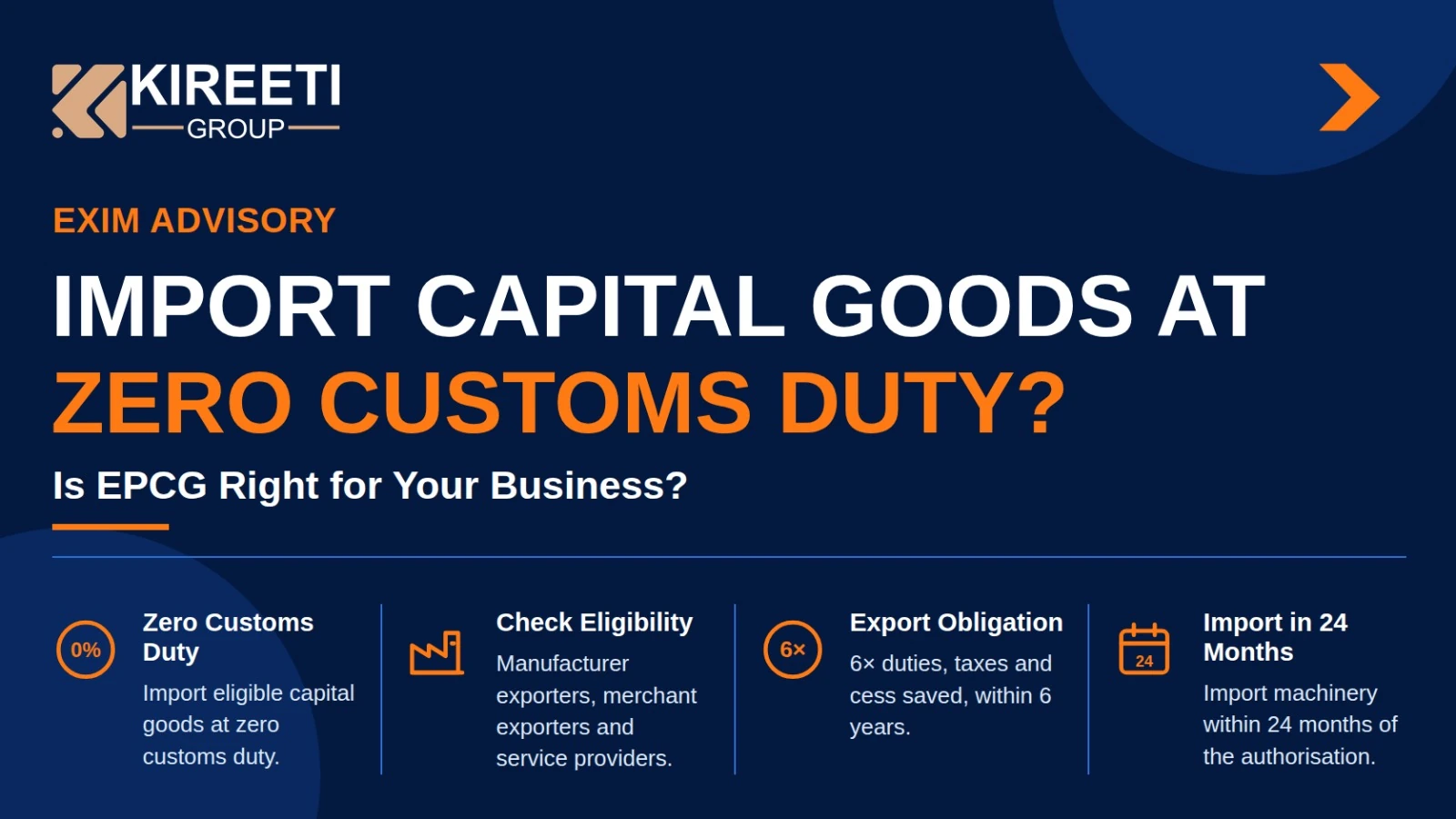
One-line answer: Yes, you can import your capital goods (machinery) at zero customs duty through the EPCG route. Whether the EPCG route is right for you will depend on various factors.
The EPCG Scheme allows eligible exporters to import capital goods at zero customs duty. For physical exports, IGST and Compensation Cess are also exempted. In return, you have to fulfil an Export Obligation equal to 6 times the duties, taxes and cess saved within 6 years from the date of the EPCG Authorisation.
Quick Facts
| Particular | Key Information |
|---|---|
| Who can use EPCG? | Manufacturer exporters, merchant exporters linked with a supporting manufacturer, and service providers (FTP 2023, Para 5.02(a)). |
| Time to import machinery | Machinery must be imported within 24 months from the date of issue of the EPCG Authorisation (FTP 2023, Para 5.01(d)). |
| Installation Certificate | The Installation Certificate must be submitted within 3 years after importing the machinery (HBP 2023, Para 5.04(a)). |
| Export Obligation | 50% of the Export Obligation must be completed within the first 4 years, and the remaining 50% during the 5th and 6th years (HBP 2023, Para 5.13). |
| Sale or transfer of machinery | You cannot sell or transfer the imported machinery until you complete your Export Obligation and the EODC is obtained (FTP 2023, Para 5.03). |
Scroll left to see the full table
Businesses planning to import eligible capital goods at zero customs duty can consult EPCG Scheme Consultants to assess eligibility, potential duty savings and Export Obligation requirements.
Is EPCG Right for Your Business?
It may suit you if:
- You are an eligible manufacturer exporter, a merchant exporter linked with a supporting manufacturer, or a service provider.
- The machinery you are planning to import involves significant customs duty, which makes the EPCG scheme beneficial for your business.
- You are confident that you can fulfil the Specific Export Obligation within the period allowed and meet the Average Export Obligation (AEO), where required.
How the Process Works
- Obtain the required Chartered Engineer's nexus certificate.
- File ANF 5A with the Regional Authority and pay the applicable fee.
- Complete the required Customs registration, Bond and Bank Guarantee, wherever applicable.
- Import the capital goods within 24 months.
- Install the capital goods in your premises and submit the Installation Certificate within the prescribed period.
- Fulfil your Export Obligation through eligible exports, supplies or services covered by the EPCG Authorisation.
- Meet the applicable Average Export Obligation and submit the prescribed EO report.
- Apply for the EODC in ANF 5B after you complete your Export Obligation.
Example: Imported Machine Worth ₹50 Lakh – What Is Your Export Obligation?
A manufacturer imports an eligible machine with a value of ₹50,00,000. The rates mentioned below are illustrative only.
| Particulars | Rate × Base | Amount |
|---|---|---|
| Basic Customs Duty | 7.5% × ₹50,00,000 | ₹3,75,000 |
| Social Welfare Surcharge | 10% × ₹3,75,000 | ₹37,500 |
| IGST | 18% × ₹54,12,500 (CIF + BCD + SWS) | ₹9,74,250 |
| Total duties, taxes and cess saved | ₹13,86,750 | |
| Export Obligation | 6 × ₹13,86,750 | ₹83,20,500 |
Scroll left to see the full table
What Does This Mean?
A ₹50 lakh machine does not mean that your Export Obligation is ₹3 crore.
In this example, the exporter has to fulfil an Export Obligation of ₹83,20,500 within 6 years from the date of the EPCG Authorisation, and this period can be extended.
₹41,60,250 (50%) must be fulfilled within the first 4 years, and the remaining ₹41,60,250 in years 5 and 6.
What Happens Next?
After you import:
- Install the capital goods in your premises and submit the Installation Certificate within the prescribed period.
- Fulfil your Export Obligation through eligible exports allowed under the EPCG Authorisation.
- Complete 50% of the Specific Export Obligation in the first four years and the balance in years 5 and 6.
- Meet the Average Export Obligation as well.
- Apply for the EODC in ANF 5B once you have completed your Export Obligation.
Latest Updates
- Public Notice No. 15/2024-25 dated 25 July 2024: The time for submitting the Installation Certificate has been changed to 3 years from the date the imports are completed. The prescribed extension is also available.
- Public Notice No. 24/2024-25 dated 20 September 2024: The EO report is now required to be filed after the first 4-year block, and then continuously until the end of the EO period.
- Policy Circular No. 10/2025-26 dated 26 February 2026: DGFT has given Average Export Obligation (AEO) relief for 2024-25 for certain product groups whose exports fell by more than 5% compared to 2023-24, subject to the conditions mentioned in the circular.
Why Kireeti Group
EPCG can give a major duty benefit, but the Export Obligation and compliance requirements need to be planned from the start.
Kireeti Group can assist with:
- EPCG eligibility and duty-saving assessment.
- Nexus certificate coordination and ANF 5A filing.
- Customs registration, Bond, Bank Guarantee and other formalities.
- Export Obligation and Average Export Obligation tracking.
- EODC filing and closure support.
Planning a machinery import? Talk to Kireeti Group before you file.
EPCG consultants can help exporters understand whether the EPCG route is suitable for their machinery import, calculate the potential duty benefit and Export Obligation, and manage the documentation and compliance process. The scheme is particularly relevant when the capital goods involve significant customs duty and the exporter can fulfil the required Export Obligation within the prescribed period.
Official Sources
- Foreign Trade Policy 2023, Chapter 5.
- Handbook of Procedures 2023, Chapter 5.
- Customs Notification No. 16/2015-Customs dated 01.04.2015, as amended.
- DGFT Public Notice No. 15/2024-25 dated 25.07.2024.
- DGFT Public Notice No. 24/2024-25 dated 20.09.2024.
- DGFT Policy Circular No. 10/2025-26 dated 26.02.2026.
- DGFT Trade Notice No. 15/2026-27 dated 05.08.2026.
- DGFT Appendix 5E – Computation of Annual Average Export Obligation under EPCG.