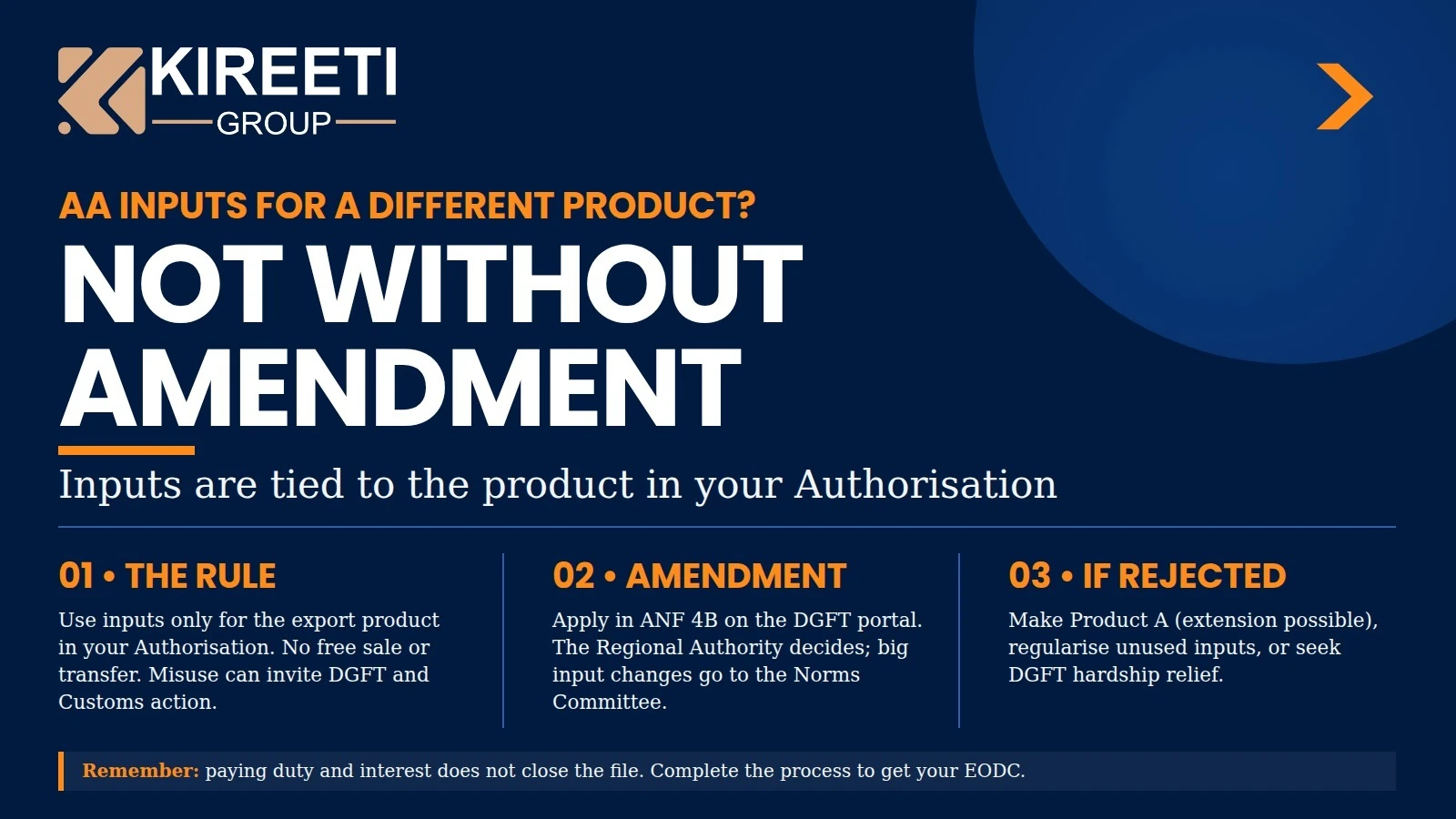
No, not directly. If you imported raw materials duty-free under an Advance Authorisation (AA) to make Product A, you cannot simply use them for Product B just because it also requires the same materials.
The Short Answer
The export product and the inputs that are allowed are mentioned within your Authorisation. If Product B is not covered, contact the Regional Authority who has issued the Authorisation to determine if an amendment is possible. Obtain the required approval before using the inputs for Product B.
If you use your inputs against the conditions of your Authorisation, action may be taken under DGFT and Customs laws.
Why Your Authorisation Decides This
- It tells you what is allowed: Your Authorisation specifies what you can export, what you can import, quantities and values, and limits of time, etc. (HBP 2023, Para 4.26).
- The inputs must be used to make the approved export product: You should use the imported inputs for making the export product which is covered under your Authorisation, and it also allows wastage under the scheme.
- Inputs cannot be transferred freely: You cannot freely sell or transfer the inputs imported under Advance Authorisation, even if you have completed your total export obligation.
- Customs also checks which product you export: You must meet your export obligation by exporting the products which are mentioned in your Authorisation, as required under Customs Notification No. 21/2023-Customs.
How to Amend Your Authorisation
If required, you can apply for amending your Authorisation to change the export product, an input, or the quantity of an input under SION or ad-hoc norms (HBP 2023, Para 4.24). But it doesn't mean that approval is granted automatically.
- Apply online. Apply for the change on the DGFT portal in ANF 4B with reasons for the change.
- Wait for approval. The Regional Authority will review your request, with the specific approval of its Head of Office.
- Some changes need further review. If inputs are to be changed significantly, or wastage is required to be higher than the norms, this is taken to the Norms Committee for ratification.
You must also meet the applicable minimum value addition, as per the rules mentioned under the scheme (FTP 2023, Para 4.09).
If the Amendment Is Not Approved
If your request to change the Authorisation is rejected, you still have a few options.
- Use the inputs for Product A. If possible, make Product A and complete your export obligation within the time allowed to fulfil it. You can also apply for an extension, but subject to the required fee and conditions under the scheme.
- Settle the unused inputs. If you cannot use the inputs, then check whether you can regularise them.
- Ask DGFT for relief. In case of genuine hardship, special relief can be sought under Chapter 2 of FTP 2023.
Regularising Unused Inputs
If you cannot complete your export obligation, you may have to pay duty and other charges, depending on the shortfall (HBP 2023, Para 4.49).
- Export quantity is short: You may have to pay duty and interest on unused materials.
- Export value is short: If you meet the minimum value addition, no penalty applies for the value shortfall. Otherwise, you may have to pay the prescribed amount.
- Both are short: The charges depend on the shortfall.
- You used less material than imported: You may have to pay duty and interest on unused materials.
The rules may differ depending on when your Authorisation was issued, so check with the Regional Authority before making any payment.
Paying the Duty Does Not Close the File
Paying the duty and interest is not the final step. The Regional Authority will check your payment and complete the process, which will close your Authorisation.
- Pay the amount due: Pay the applicable duty and interest required by the authorities.
- Submit the proof: Send the payment receipt and calculation details to the Regional Authority.
- Complete the closure process: Submit the required documents and follow the applicable procedure to obtain the EODC.
Checklist
- Check the export product, inputs and quantities on your Authorisation (HBP 4.26).
- Record whether it was issued under SION, ad-hoc norms or self-declaration, and the date of issue.
- Check what your export obligation period is.
- Confirm the amendment procedure, apply, and wait for approval (HBP 4.24).
- Be sure to have Bills of Entry, shipping bills and consumption records, as required.
Official Sources
- Chapters 2 and 4 of Foreign Trade Policy 2023
- Chapter 4 of Handbook of Procedures 2023
How Kireeti Group Can Help
- Check your Advance Authorisation and see if you can make an amendment.
- Assist in preparing and presenting the amendment application.
- Guide you in regularising unused inputs if the amendment does not get approved.
- Support the documents and EODC process as needed.
Need help with your Advance Authorisation? Contact Kireeti Group for guidance.