epcg 2nd export obligation period update
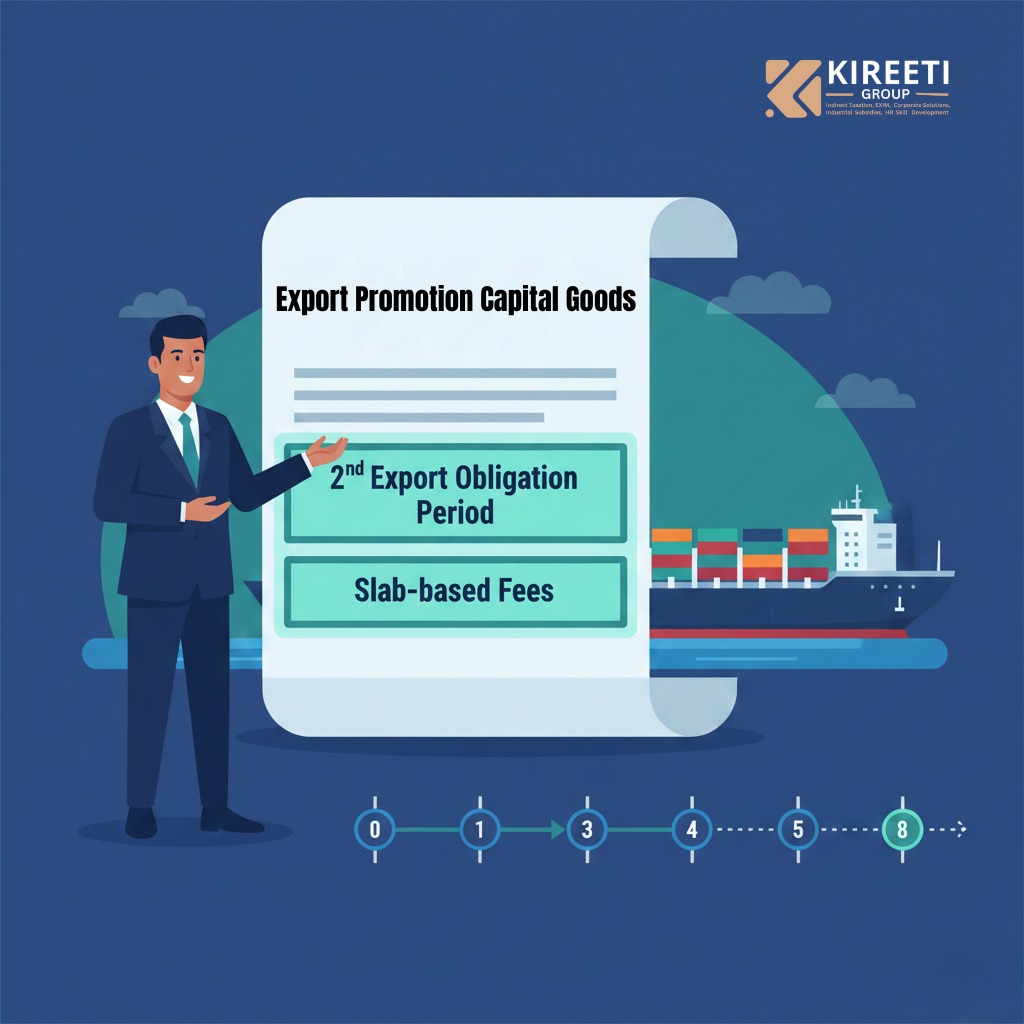
DGFT Public Notice No. 15/2024-25 – Major Relief for EPCG: 2nd Export Obligation Period
Public Notice No. 15/2024-25 dated 25 July 2024 introduces a significant procedural relaxation under the Export Promotion Capital Goods (EPCG) scheme by amending Para 5.16(b) of the Handbook of Procedures (HBP). This change directly benefits EPCG authorisation holders who have pending export obligation (EO) after the 2nd Export Obligation Period (5th–6th year) and are seeking extension of the EO period beyond the initial 6 years. The intent of this amendment is to simplify extension procedures, reduce cost uncertainty, and offer exporters greater flexibility in managing EO timelines.
What has been amended in Para 5.16(b)?
Earlier, Para 5.16(b) permitted extension of the EO period beyond 6 years through two separate extensions of 1 year each, subject to a composition fee of 2% of the proportionate duty saved on the unfulfilled EO for each year of extension, with a minimum fee of ?10,000. This method often resulted in higher costs and complex calculations for exporters reaching the end of the 2nd Export Obligation Period. Under the revised Para 5.16(b), an EPCG authorisation holder may now:
- Opt for two individual 1-year extensions, or
- Apply for one consolidated 2-year extension in a single application beyond the original 6-year EO period.
More importantly, DGFT has replaced the percentage-based composition fee with a fixed, slab-based fee linked to the duty-saved value, making the process simpler and more predictable when EO remains unfulfilled after the 2nd Export Obligation Period.
New slab-based composition fee structure
As per Public Notice No. 15/2024-25, the composition fee for EO period extension beyond 6 years (up to a maximum of 8 years) is now as follows:
- Duty saved up to ?2 crore – Composition fee of ?20,000
- Duty saved above ?2 crore and up to ?10 crore – Composition fee of ?30,000
- Duty saved above ?10 crore – Composition fee of ?60,000
These fixed fees apply irrespective of whether the exporter chooses one combined 2-year extension or two separate 1-year extensions after the 2nd Export Obligation Period. The public notice also clarifies that where an exporter has already paid a higher composition fee under the earlier 2% formula for similar extensions, the excess amount shall be refundable, ensuring uniform treatment of past and future cases.
Why this change is important for the 2nd Export Obligation Period
For many EPCG authorisation holders, compliance challenges become most acute at the end of the 2nd Export Obligation Period (years 5–6) when part of the EO remains pending. The revised Para 5.16(b) offers several advantages:
- Extension costs are now capped and predictable, instead of increasing in proportion to unfulfilled EO.
- Exporters can secure the full 2-year extension in a single application, enabling better planning of production, sales, and export schedules.
- DGFT has clearly positioned this amendment as an ease of doing business measure under FTP 2023, shifting the focus from penalisation to practical regularisation of genuine delays.
This relief is particularly valuable for industries with long gestation projects, where exports may scale up only towards or after the 2nd Export Obligation Period.
Related EPCG relaxations under Public Notice No. 15/2024-25
In addition to Para 5.16(b), the public notice introduces two related relaxations that strengthen EPCG compliance across the entire EO lifecycle:
- Installation certificate timeline (Para 5.04(a))
The period for submission has been extended from 6 months to 3 years from the date of completion of imports. Further extension is permitted up to the EO period on payment of a composition fee of ?10,000 per year beyond 3 years. - First block EO extension (Para 5.13(c))
Extension of the 1st Export Obligation Period now follows a slab-based composition fee linked to duty-saved value, making it easier and more economical to regularise shortfalls before reaching the 2nd Export Obligation Period.
Together, these amendments create a more structured, predictable, and exporter-friendly EPCG framework, covering capital goods installation, 1st block EO compliance, and EO extensions required after the 2nd Export Obligation Period.