e brc in epcg scheme implementation guide
e BRC Implementation in the EPCG Scheme: A Complete Guide
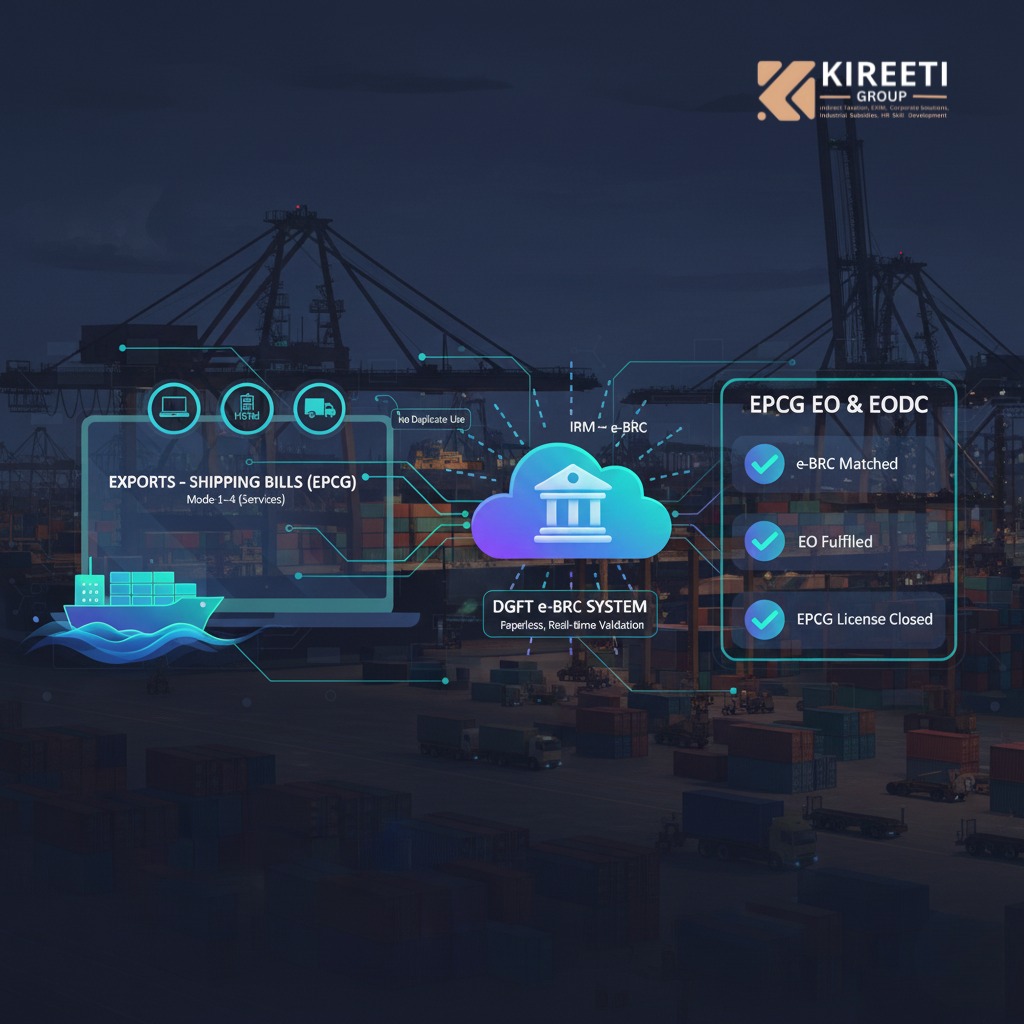
e BRC implementation now sits at the heart of compliance under the Export Promotion Capital Goods (EPCG) scheme, because DGFT uses it as the primary proof that export proceeds linked to EPCG shipments have actually been realised in foreign exchange.
What e BRC is and why EPCG depends on it
- An e BRC (Electronic Bank Realisation Certificate) is a digital certificate issued on the DGFT platform based on inward remittance data sent by banks, confirming that export payment for specific shipping bills has been received.
- DGFT explicitly lists EPCG as one of the schemes that rely on e BRC data to grant benefits and verify export obligation, alongside Advance Authorisation and FTP incentive schemes.
For EPCG holders, this means that export obligation (EO) is counted only when both the shipping bill and corresponding e BRC exist and match in the DGFT system.
How e BRC flows into EPCG records
- Export and remittance
You export goods or services under EPCG; shipping bills must mention EPCG licence details as per Chapter 5 conditions. Foreign buyer pays through your authorised dealer (AD) bank. - Bank uploads IRM and e BRC
The bank sends electronic Inward Remittance Messages (IRMs) to DGFT’s enhanced e BRC system, which now supports self certification by exporters based on these IRMs. e BRC is then generated or confirmed on the DGFT portal and linked to specific shipping bills. - DGFT reads e BRC for EPCG
When you file returns on EO fulfilment or later apply for EODC (ANF 5B), DGFT’s system pulls export realisation data from the e BRC database to verify that export values claimed under EPCG are actually realised. If e BRC is missing or mis linked, those exports may not be credited towards EPCG EO.
e BRC in EPCG EO monitoring and EODC
- Chapter 5 procedures require EPCG authorisation holders to report EO fulfilment online to the RA, with shipping bills and realisation proof; practically, this now means shipping bills plus e BRC data.
- At the time of EPCG EODC (redemption), ANF 5B and consultant guides show e BRC as a core document alongside shipping bills and EO calculation sheets; RAs frequently cross check values with the e BRC system rather than relying only on manual certificates.
- For third party export support to an EPCG holder, guidelines insist that the same shipping bills and e BRC must not be used for any other EPCG licence, and often require a disclaimer confirming this.
So, e BRC is the anchor that connects EPCG EO claims to actual banked export proceeds.
2025 e BRC rule for service based EPCG exports
- From 1 May 2025, DGFT has added a new requirement: all service exports must have the “Mode of Export of Services” (GATS Mode 1–4) captured in e BRC.
- For EPCG holders in services sectors (hotels, IT, logistics, etc.) who fulfil EO partly via services, banks and exporters must ensure the correct export mode is recorded when generating e BRC.
- DGFT can now better validate that services counted towards EO genuinely qualify as exports under WTO consistent definitions, which will influence EO assessment during EODC.
Missing or incorrect mode coding may result in queries or non acceptance of those services towards EO.
DGFT’s revamped e BRC system and benefits for EPCG
- Paperless, cost free process: e BRCs are generated on the DGFT portal based on bank IRMs, eliminating older paper BRC workflows and reducing dependency on manual bank letters.
- Faster validation and scaling: The system is designed to handle large transaction volumes, giving DGFT near real time data to validate EO for schemes like EPCG.
- Targeted risk checks: Banks and DGFT can focus on outliers instead of manually checking every transaction, which can speed up routine EPCG EODC where e BRC data is clean and consistent.
For compliant exporters, this translates to quicker EO recognition and faster closure of EPCG licences.
Practical compliance tips for EPCG exporters on e BRC
- Map shipping bills and realisations carefully: Share precise shipping bill numbers and IEC with your bank so e BRC mapping is accurate. Before filing EO reports or ANF 5B, confirm that all relevant e BRCs appear correctly in DGFT dashboards.
- Avoid duplicate usage: Ensure that the same e BRC and shipping bill combination is not claimed against multiple EPCG licences or conflicting schemes where disallowed.
- For services under EPCG: Train finance and operations teams on the new GATS mode field and keep documentation that supports the mode selected for each service e BRC.
- Align EO statements with e BRC data: EO calculations should reconcile with e BRC realisation figures to minimise DGFT deficiency letters and speed up EODC.
In effect, robust e BRC implementation ensures that every rupee of export realisation that an EPCG holder earns is correctly captured and credited towards its export obligation, making the journey from import of capital goods to final EPCG closure smoother, more transparent and less risky.