advance authorisation invalidation latest update
Advance Authorisation Invalidation: Latest DGFT Update
The Invalidation facility under the Advance Authorisation scheme allows exporters to source inputs from Indian manufacturers instead of importing them directly, without losing the duty-free benefit. Traditionally, many exporters avoided this option because procedures were paper-heavy and unclear. Recent DGFT upgrades have moved Invalidation fully onto the new online portal, with dedicated services, standardised forms, and clearer checklists, making it far more practical for day-to-day use.
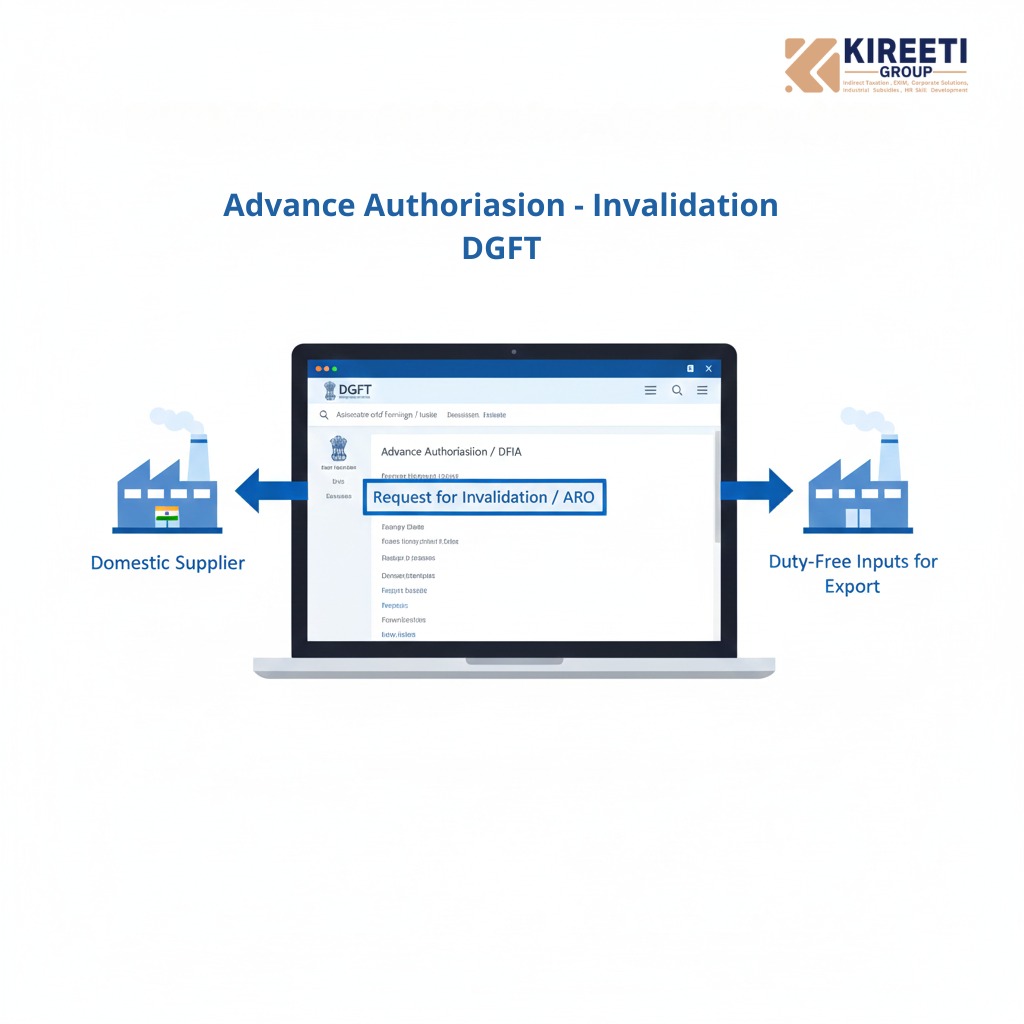
On the DGFT portal, Invalidation now appears as a specific service under the “Advance Authorisation / DFIA” module, grouped along with ARO and Certificate of Supplies. Exporters can log in with their IEC-linked credentials, select the “Request for Invalidation / ARO / Cos” option against a particular Advance Authorisation, and file the complete request digitally. The current system is based on ANF-4E (Invalidation/ARO), but instead of offline submission, all licence details, supplier details, quantities to be invalidated, and fee payments are entered and uploaded online.
Practically, the workflow is now very clear. First, the Advance Authorisation holder decides which items and quantities they wish to procure domestically rather than import. Next, they identify a domestic supplier and capture key information such as IEC, address, MSME/Udyam or industrial registration, and purchase offer. Using the portal, they then file the Invalidation request: selecting the licence, filling item-wise mapping to the AA (item serial number, quantity, CIF value), and attaching supporting documents like the AA copy, supplier registration, and quotations. Finally, they pay the DGFT fee online and sign the application digitally.
Once submitted, the Regional Authority can scrutinise the application entirely through the portal. Any deficiency or clarification is raised as an online query instead of physical letters. After the RA is satisfied, an Invalidation Letter is issued in favour of the named domestic supplier and is visible/downloadable through the same DGFT account. This letter confirms that the licence will not be used for direct imports to that extent and that the domestic supplier is authorised to supply those inputs under duty-free arrangements (usually by taking an Advance Intermediate Authorisation for their own imports).
For exporters, these digital changes have two important benefits. First, they can now combine Advance Authorisation benefits with “Make in India” sourcing far more smoothly, using domestic manufacturers without increasing input cost. Second, the online system reduces procedural friction: no manual filing, standardised ANF-4E structure, integrated fee payment, and clear tracking of Invalidation, ARO, and related services in one place. For domestic suppliers, this route opens a steady pipeline of export-linked orders where they can also access duty-free inputs and compete effectively with foreign suppliers. With more parts of the Advance Authorisation scheme—amendments, redemption/EODC, and now Invalidation—being digitised, exporters who adopt the portal-based process early are likely to see faster approvals and fewer compliance disputes.