advance authorisation 2nd revalidation update
Dated. October, 2025
Issued By. DGFT
Subject: Advance Authorisation – 2nd Revalidation Policy Update
*****
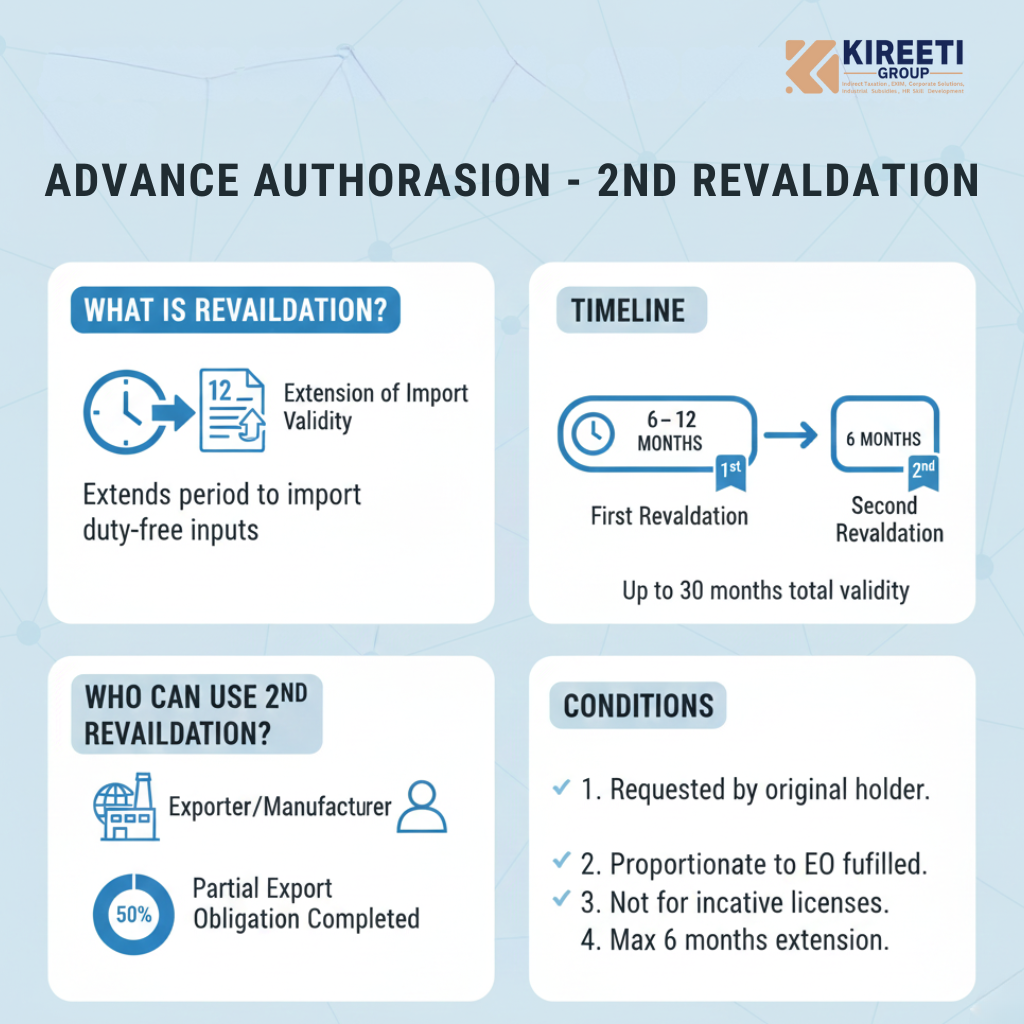
Advance Authorisation 2nd Revalidation
The latest key change is that for Advance Authorisations issued on or after 15.08.2020, only one revalidation of import validity for 12 months is now allowed
The earlier facility of two revalidations of 6 months each does not apply to these licences.
Change in revalidation rule
- DGFT amended para 4.41 of the HBP 2015 20 to state that AAs issued on or after 15.08.2020 are eligible for only one revalidation of 12 months from the expiry date, and “no further revalidation would be allowed” for such authorisations.
- The same amendment clarifies that para 4.41(c) (which provided first and second revalidation of 6 months each) is not applicable to these post 15.08.2020 AAs, effectively withdrawing the 2nd revalidation option for new licences.
Position of the earlier 2nd revalidation facility
- For older AAs (issued before 15.08.2020), the earlier framework under Public Notice 63/2015 20 still explains how RAs could grant first and second 6-month revalidations, but this applies only to those legacy authorisations within their policy period.
- Current practice and circulars emphasise that new AAs cannot claim 2nd revalidation as a matter of right; they are confined to the single 12-month revalidation limit unless covered by a separate, special COVID-type blanket extension or future relaxation.
Challenges After Withdrawal of 2nd Revalidation
- Tighter import planning window
With only one 12-month revalidation allowed for AAs issued on or after 15.08.2020, importers have less flexibility to handle delays in sourcing, trials, or approvals, increasing the risk of unutilised licences. - Higher risk of losing duty benefit
If imports are not completed within original validity plus the single revalidation, businesses may have to forgo planned duty-free imports or seek costly policy relaxations, affecting project viability and margins. - Greater compliance pressure on EO-import alignment
Since there is no 2nd revalidation to fall back on, firms must align import schedules closely with export timelines; any slippage can disturb cash flows and complicate EO fulfilment and EODC closure. - Limited remedy for unforeseen disruptions
Earlier, a 2nd revalidation could help absorb shocks like supplier default or logistics disruption; now, apart from occasional blanket extensions (COVID-related), regular policy offers no such extra buffer.