advance authorisation 2nd eop extension
Dated. October, 2025
Issued By. DGFT
Subject: Advance Authorisation – 2nd Export Obligation Period
*****
2nd Export Obligation Period Under Advance Authorisation
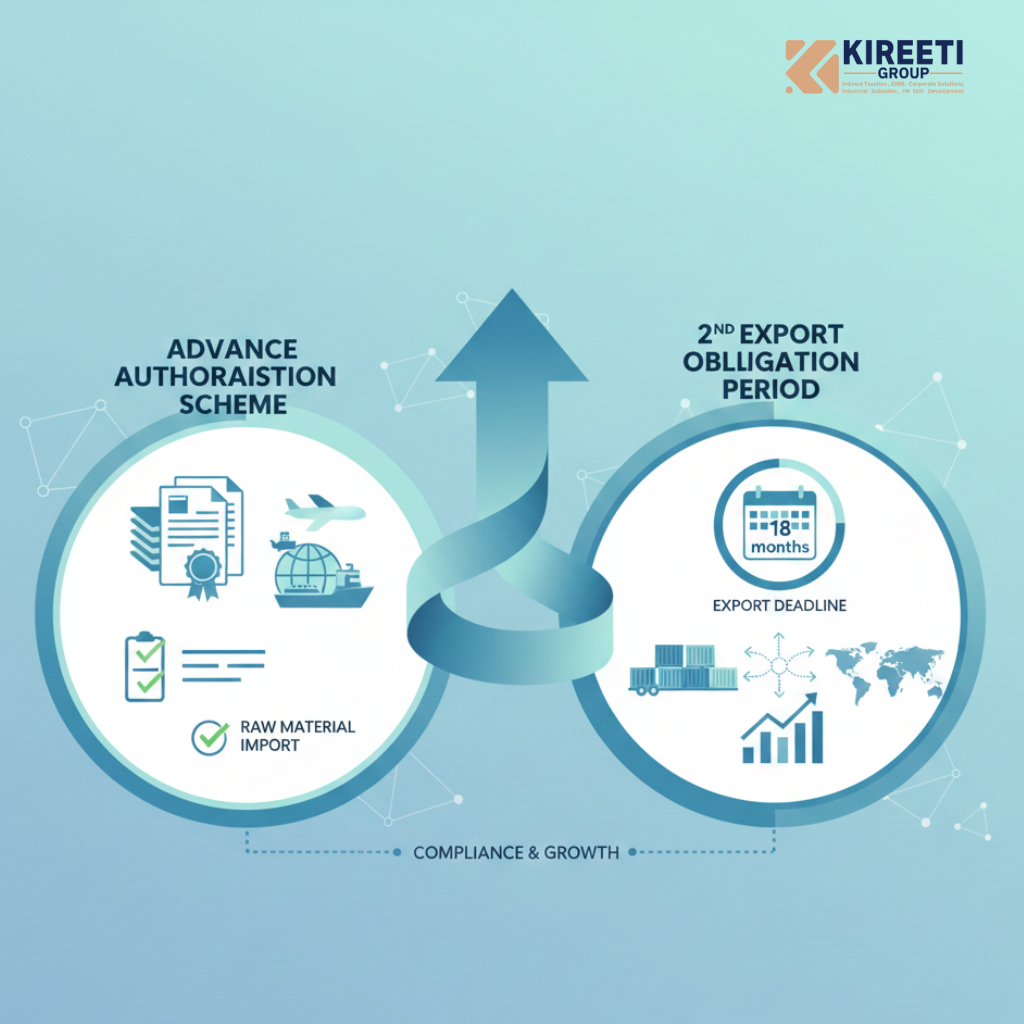
For standard Advance Authorisations, the base Export Obligation Period remains 18 months from the date of issue of the authorisation, unless DGFT specifically prescribes a different period for a particular product or sector. Within this 18-month window, the exporter is expected to complete the full export obligation arising from duty-free imports. DGFT still permits EOP extensions in deserving cases. These are not separate “blocks” but additional time added to the original EOP, subject to conditions, composition fees, and timely application with the Regional Authority (RA DGFT).
How do the 1st and 2nd Export Obligation Period extensions work in practice?
In practical trade language, exporters often refer to the two possible EOP extensions as “1st EOP” and “2nd Export Obligation Period”, but policy treats them simply as first and second extensions of the same EOP. For normal Advance Authorisation cases:
- Base EOP: 18 months from issue.
- 1st extension: DGFT may grant a 6-month extension on application in ANF 4D with payment of a composition fee on the unfulfilled export obligation.
- 2nd extension: A further 6-month extension may be considered, again on payment of a composition fee and subject to conditions and overall caps.
As a result, for most standard authorisations, the maximum EOP effectively becomes about 30 months (18 + 6 + 6) from the date of issue, provided both extensions are duly approved. Exporters should treat this as the outer time limit in normal circumstances.
Latest product-specific developments: QCO and jewellery cases
While the broad EOP framework continues, DGFT has introduced important product-specific clarifications and restrictions.
- Quality Control Order (QCO) covered products: For Advance Authorisations used to import items that fall under mandatory Quality Control Orders of various ministries (such as BIS-mandated products), DGFT has clarified that the EOP will be 18 months in line with para 4.40 of the Handbook of Procedures. This brings such cases in line with the general AA framework instead of shorter export windows that existed earlier for some sensitive items.
- Gold, silver, platinum, and jewellery authorisations: For certain jewellery-related Advance Authorisations, DGFT has tightened timelines and restricted EOP extensions. For example, notifications have been fixed:
- An EO period of around 120 days from import for many gold, silver, and platinum jewellery exports
- Around 180 days for specific items like findings and mountings
Online process and compliance expectations for EOP extensions
DGFT has been steadily moving EOP-related processes online, making digital compliance essential.
- Applications for EOP extension (what many in industry casually call “moving into 2nd Export Obligation Period”) must be filed electronically in ANF 4D through the DGFT portal.
- Exporters must provide a shipping bill-wise export obligation statement, details of imports, balance EO, and a justification for why the original EOP could not be met.
- Composition fee is calculated on the unfulfilled FOB value of EO as per the current FTP/HBP and must be paid online along with the application.
Recent DGFT communications also emphasise that all correspondence, deficiency memos, and approvals will be handled online, and exporters should track status using the file number generated on submission.
One-time relaxations vs. regular 2nd Export Obligation Period extensions
During events like COVID-19, DGFT issued one-time blanket extensions of import validity and EOP for specified periods and authorisation windows, often without composition fees. These temporary relaxations were meant to address extraordinary disruptions and do not replace or expand the regular framework of two 6-month EOP extensions available under the Advance Authorisation Scheme.
Going forward, exporters should assume that:
- The default rule is 18 months EOP + up to two 6-month extensions, subject to policy and fees.
- Any additional relief beyond this (like pandemic-style relaxations) will depend on specific DGFT notifications and cannot be treated as a standing entitlement.
Practical takeaways for exporters
Given the current policy landscape, businesses using Advance Authorisation should:
- Plan exports to meet as much EO as possible within the original 18-month EOP, using extensions only as backup.
- Monitor product-specific rules, especially for QCO-covered items and jewellery-related authorisations where extension possibilities may be narrower or completely barred.
- File 1st and 2nd Export Obligation Period extension applications well before expiry, with accurate EO statements and strong justifications to avoid rejection and later duty plus interest demands.
- Treat EOP extensions as a compliance privilege, not a right, and maintain clean EO tracking, documentation, and portal linkage (correct AA number mapping on shipping bills) to support EODC at the end.
Understanding that the 2nd Export Obligation Period is really the second and final EOP extension helps exporters plan realistic timelines, manage risk, and fully capture the duty-saving benefits of the Advance Authorisation Scheme.